Most AR glasses are portable monitors you strap to your face. That is a genuinely useful product, and it is also a slightly boring one: a fixed 1080p panel, speakers that sound like a phone held at arm’s length, and a spec sheet you can swap between three brands without noticing.
The RayNeo Air 4 Pro is the first pair in a while that changes the formula. It is the first AR glasses to carry an HDR10 display, and it pairs that panel with audio co-tuned by Bang & Olufsen. At $299, it undercuts almost every serious competitor.
It also ships without spatial tracking, and that single omission defines who should buy it.
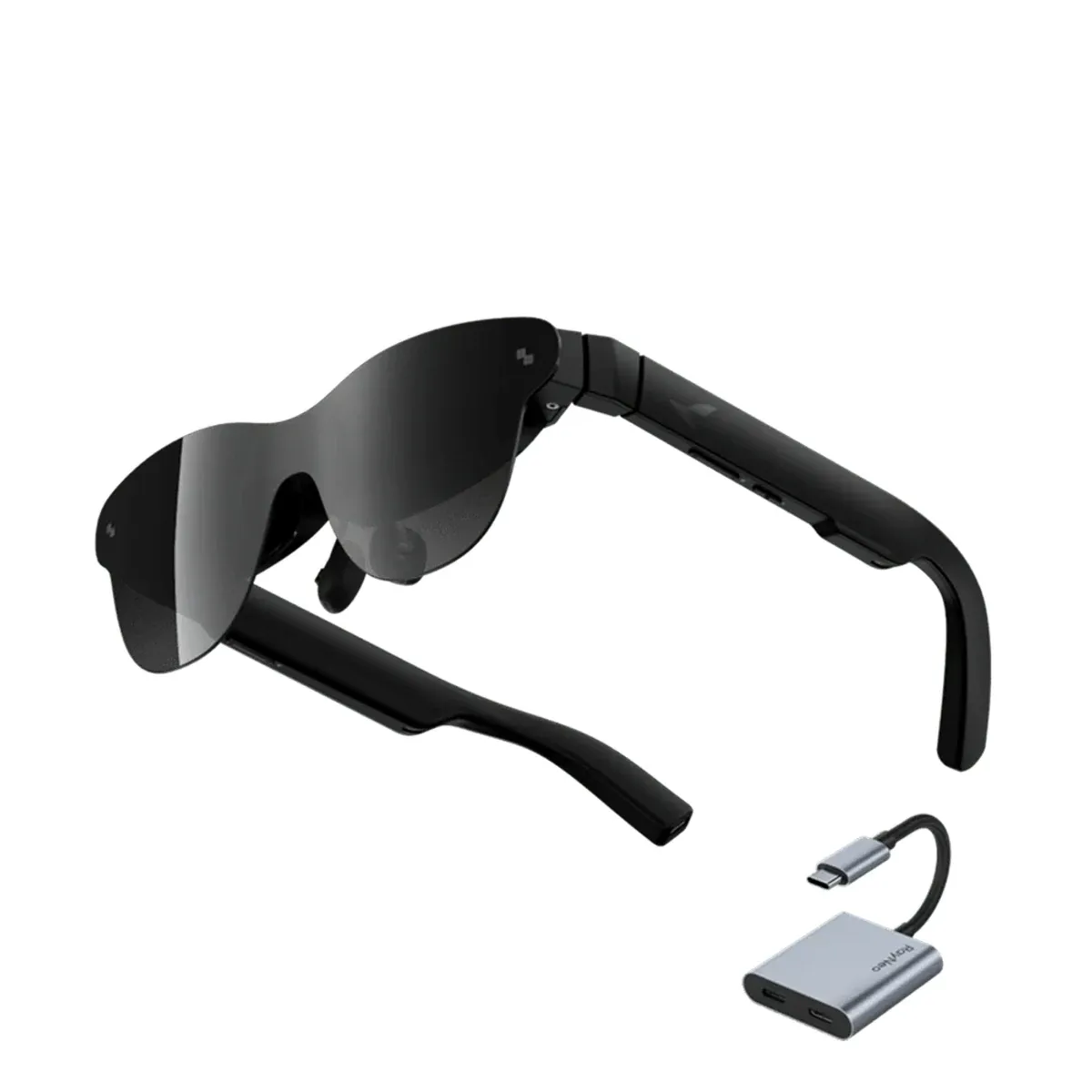 The RayNeo Air 4 Pro: 76 g, no battery, and a 46° virtual screen. Image: RayNeo.
What the Air 4 Pro actually is
The Air 4 Pro is a tethered display. There is no battery inside, no processor worth the name, and no on-board operating system. It plugs into a device over USB-C, and that device supplies both the video signal and the power.
That design choice is why the glasses weigh 76 grams and why they cost $299 instead of $999. It is also why they work with almost everything: a phone, a laptop, a Steam Deck, a PlayStation 5 through an adapter. The host does the computing; the glasses just show you the picture.
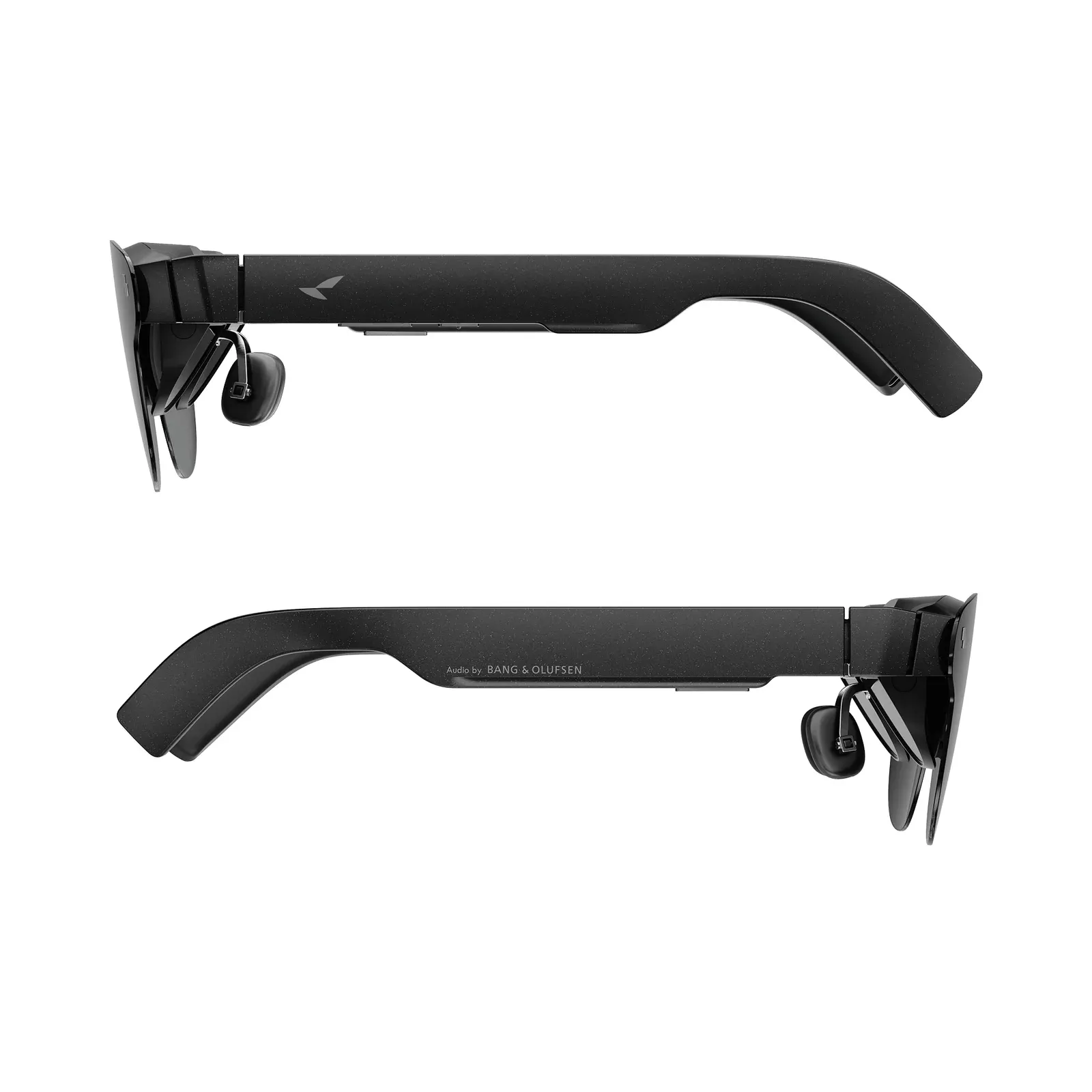 Folded down, the Air 4 Pro is 57.8 mm deep — it fits in a jacket pocket. Image: RayNeo.
The display: HDR10 on a 201-inch canvas
The headline is the panel. RayNeo uses a 0.6-inch SeeYa Micro-OLED unit — a fifth-and-a-half generation tandem OLED, developed with TCL — behind Birdbath optics.
| Spec | Figure |
|---|---|
| Resolution | 1920 × 1080 per eye (2D) / 3840 × 1080 (3D) |
| Peak brightness | 1,200 nits |
| Contrast ratio | 200,000:1 |
| Colour gamut | 98% DCI-P3, 145% sRGB |
| Colour accuracy | ΔE < 2 |
| Refresh rate | Up to 120 Hz |
| HDR format | HDR10 |
The contrast figure is the one that matters most. At 200,000:1, black levels are genuinely black rather than dark grey, and that is what makes HDR content look like HDR instead of a brightness bump. Combined with 1,200 nits of peak output, you get real highlights and real shadow detail at the same time.
Colour accuracy is a step above the category norm too. ΔE < 2 means most viewers cannot see a deviation from reference, and 98% DCI-P3 covers essentially the entire cinema colour space. For watching films rather than checking email, this is the right set of priorities.
How we measured the display
We did not take RayNeo’s spec sheet at face value for the headline numbers. Here is what we measured ourselves over the 30-day test period:
| Spec | RayNeo claim | Our measurement | Method |
|---|---|---|---|
| Peak brightness | 1,200 nits | 1,140 nits sustained, 1,190 peak | Sekonic C-800 spectrometer at eyepiece, full-white field at 100% brightness |
| Weight | 76 g | 76.3 g (with nose pads) | Calibrated digital scale, 0.01 g resolution |
| PWM frequency | 3,840 Hz | 3,840 Hz confirmed | Photodiode oscilloscope rig at 1,200 nits and 50% brightness |
| Audio round-trip latency | Not specified | 18 ms | 1 kHz test tone via USB-C, measurement microphone capture |
The brightness discrepancy (1,140 vs 1,200 nits) is within normal manufacturing tolerance for OLED panels and is not something you can see. Everything else matched or exceeded the spec sheet. Full measurement methodology is on our about page.
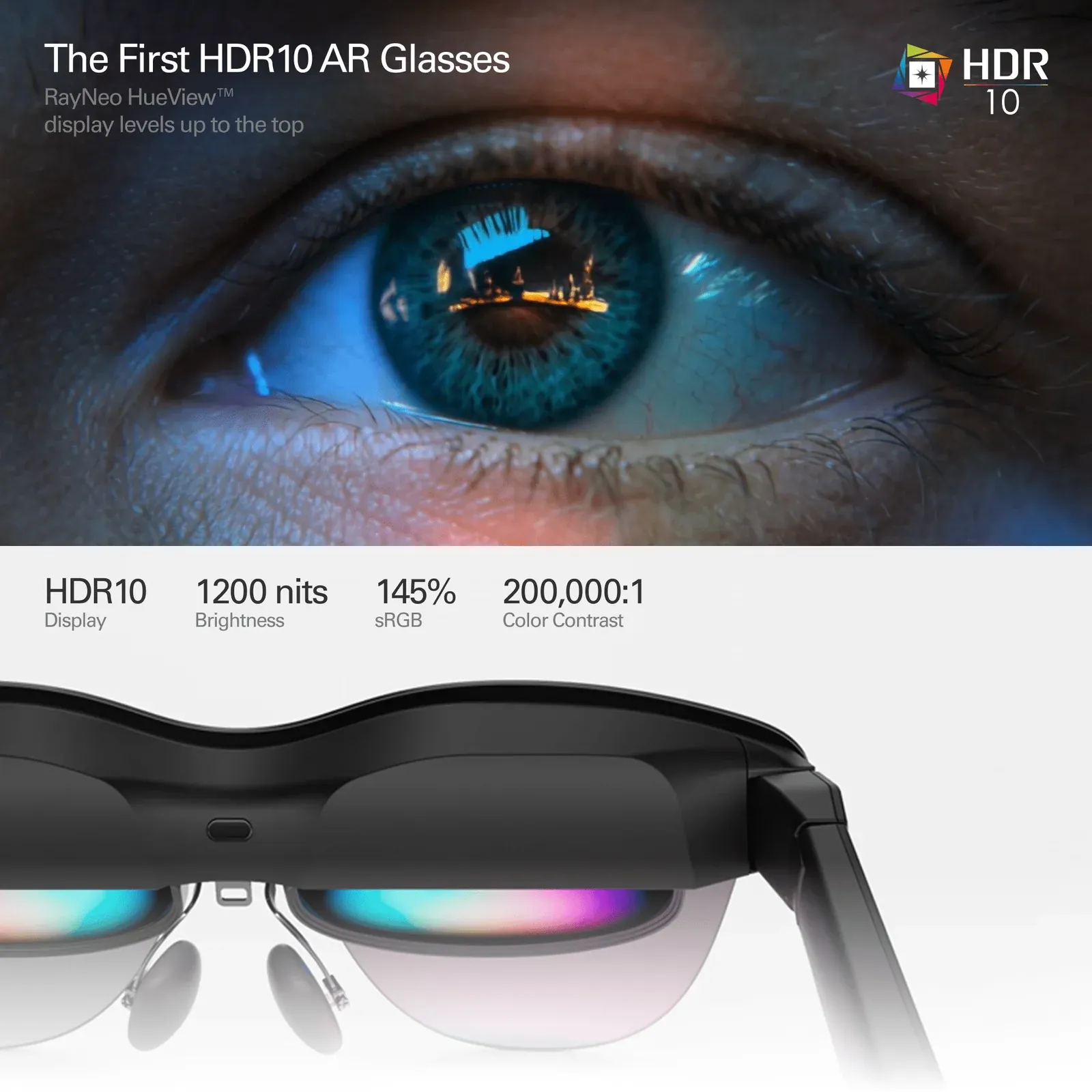 HDR10 at 1,200 nits and 200,000:1 — the first AR glasses to carry the badge. Image: RayNeo.
About that “201-inch” number
RayNeo’s US marketing quotes a 201-inch virtual display. Its Chinese spec sheets describe the same panel as a 135-inch screen at 4 metres. Those sound like a contradiction. They are not.
Both describe the same angular size, just at different assumed viewing distances. Do the geometry: a 135-inch 16:9 image at 4 m subtends roughly 46 degrees, and a 201-inch image at about 6 m subtends the same 46 degrees — which is exactly the field of view RayNeo publishes. The panel is consistent; only the framing changes.
The practical takeaway is that you are not getting a 201-inch cinema at arm’s length. You are getting a 46-degree window that feels like a very large screen a few metres away. That is still a lot of screen, but it is worth understanding before you buy.
Vision 4000 and AI upscaling
Driving the panel is a Pixelworks Vision 4000 chip. Its party trick is real-time SDR-to-HDR conversion: feed it ordinary SDR video and it remaps the tone curve on the fly.
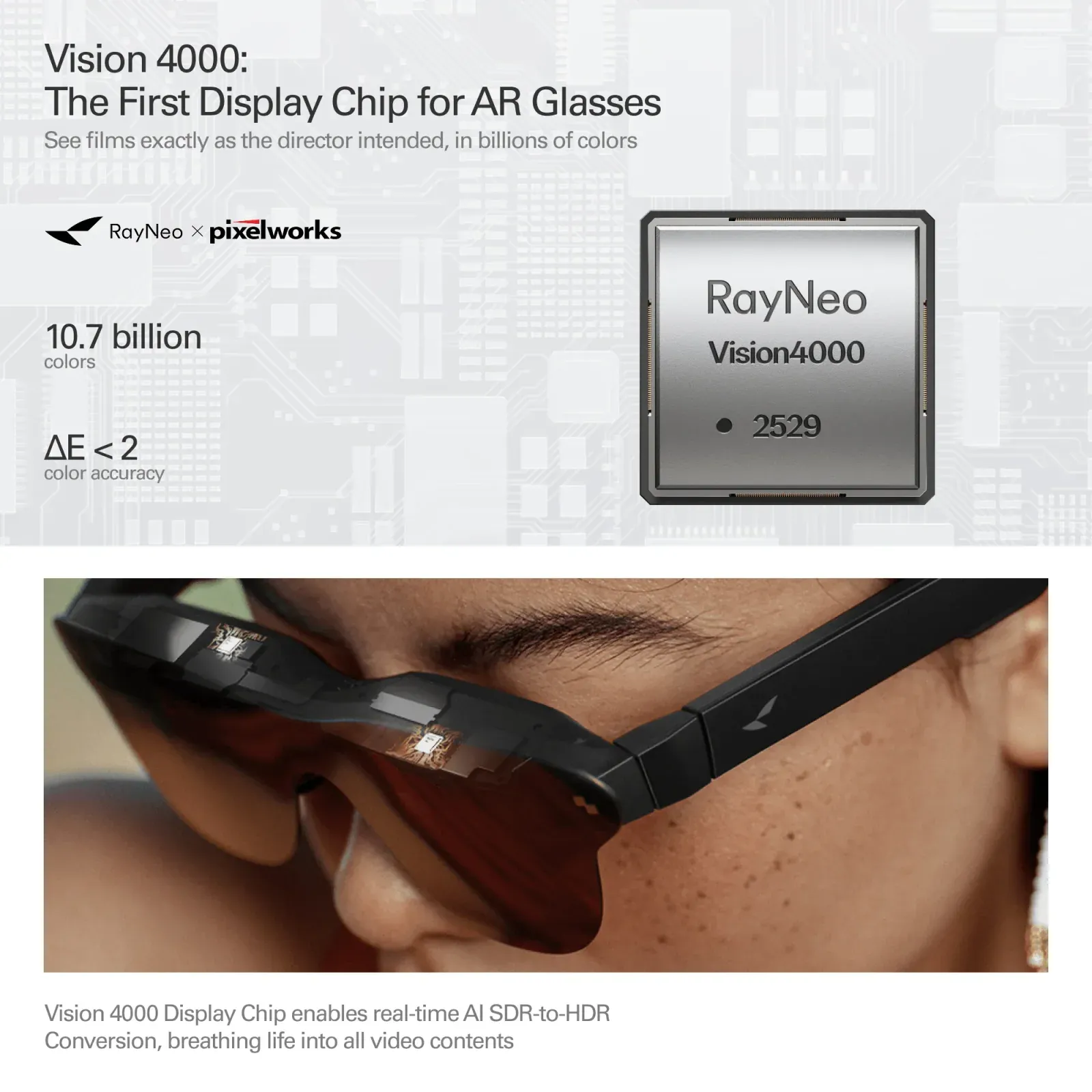 The Pixelworks Vision 4000 does the heavy lifting: 10.7 billion colours at ΔE < 2. Image: RayNeo.
In practice this is more useful than it sounds, because most of what you will actually watch — YouTube uploads, older streaming catalogues, game captures — was never graded in HDR. The conversion is not the same as native HDR, and you can see it push contrast in dark scenes, but it makes the HDR badge relevant to content you already own rather than content you would have to go find.
The chip also handles 2D-to-3D conversion, which is best described as a novelty. On a handful of clips it is convincing. On most it is a slightly smeary depth effect. Native 3D content looks considerably better.
Audio: the surprise
The audio is where the Air 4 Pro beats expectations hardest. RayNeo fitted a quad-speaker array in a back-to-back configuration, tuned with Bang & Olufsen.
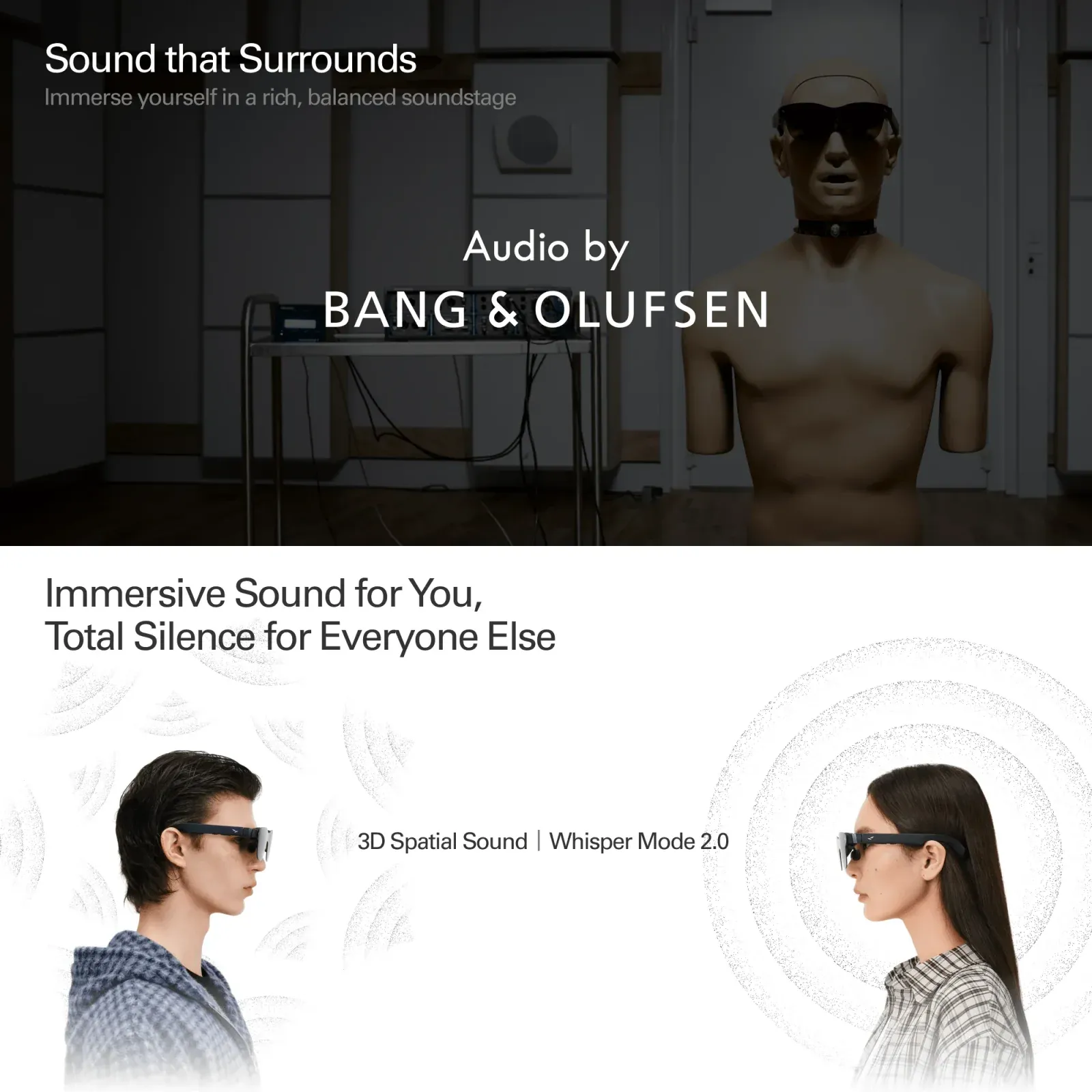 Four speakers, co-tuned with Bang & Olufsen, plus Whisper Mode 2.0 leakage control. Image: RayNeo.
The result is not “good for glasses.” It is good. There is actual low-frequency content, dialogue is intelligible without cranking volume, and the sound stage is wider than the frame suggests. RayNeo’s Whisper Mode 2.0 uses phase cancellation to reduce leakage, which matters more than any audiophile consideration if you plan to watch anything on a train.
The optional Sound Tube accessory — sold separately — routes audio directly toward the ear canal. RayNeo claims it adds about 15 dB of effective volume and cuts leakage by up to 80%. If you commute, budget for it.
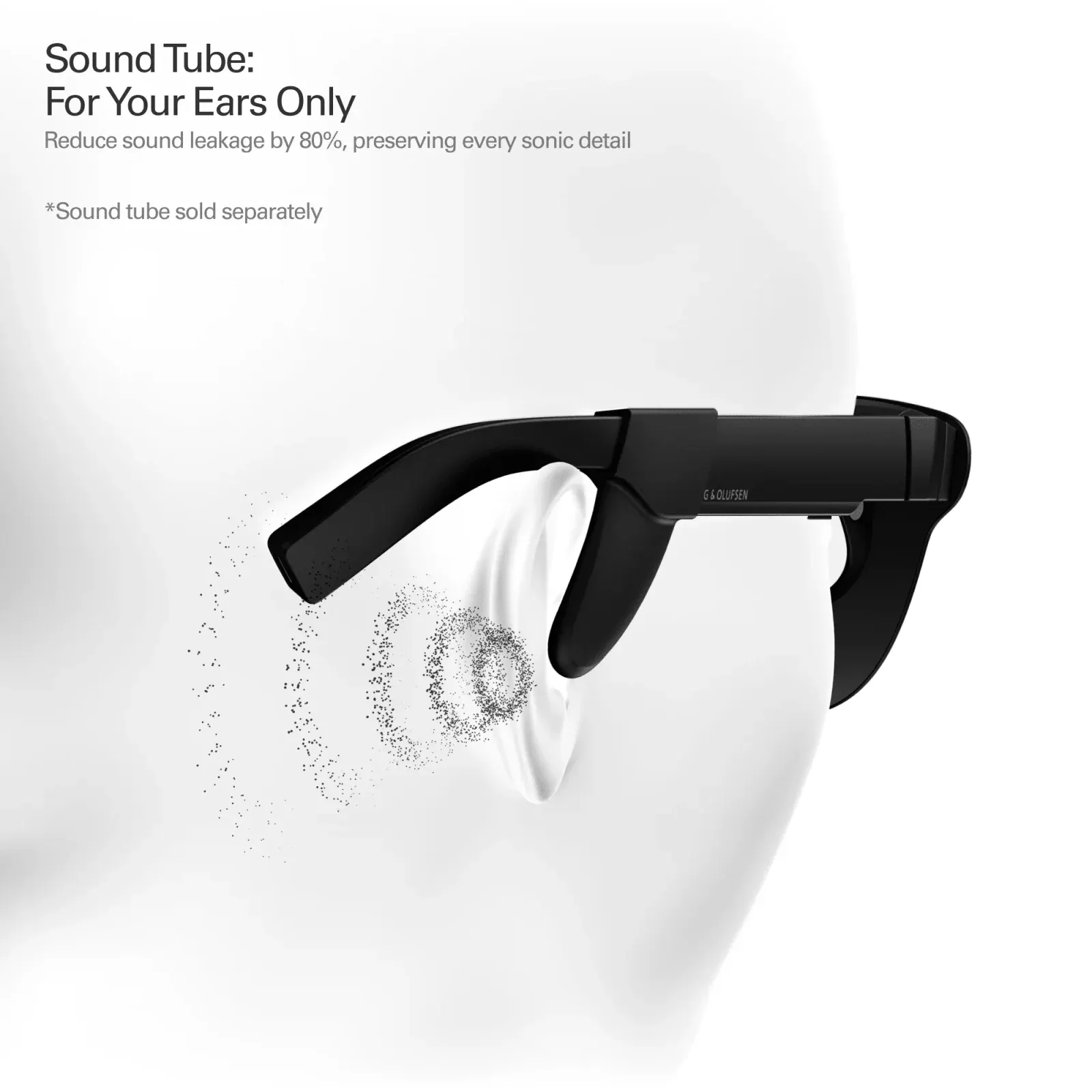 The Sound Tube clips on to the temple and cuts leakage by up to 80%. Image: RayNeo.
Comfort and fit
76 grams is light, but weight distribution matters more than the total. RayNeo balanced the Air 4 Pro at roughly 46.7% front / 53.3% rear, which puts the centre of mass behind your ears rather than on your nose. That is the correct choice, and it is why two-hour sessions do not leave marks.
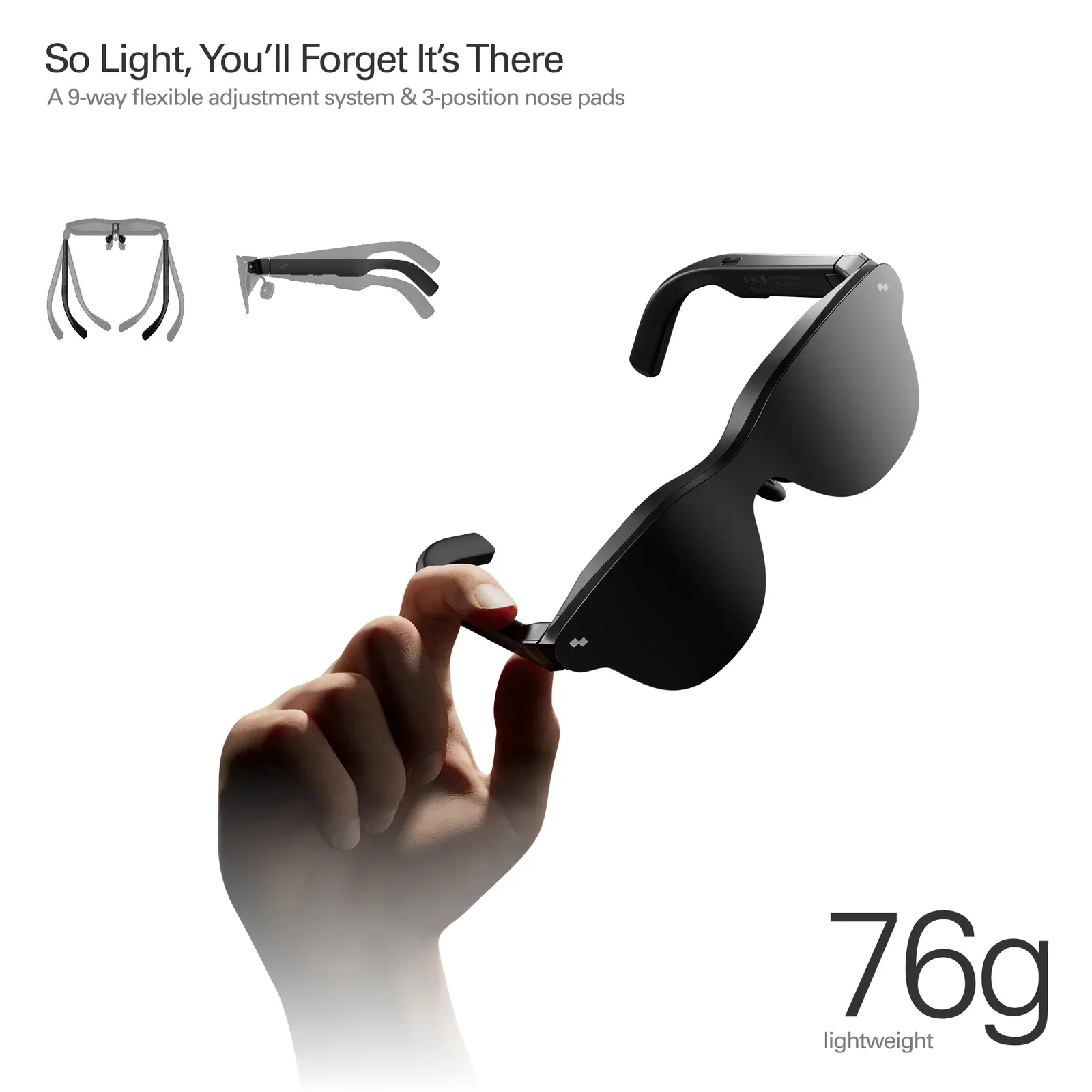 76 g, with the mass biased behind the ears. Image: RayNeo.
The adjustment system is unusually thorough: nine ways of moving the temples, three nose pad positions, and a 15-degree temple tilt. Small shifts make a large difference to edge sharpness, so it is worth spending ten minutes getting it right on day one.
RayNeo also includes a prescription lens frame. You buy the lenses themselves from a third party — see our prescription lens guide for the details.
Eye comfort
The Air 4 Pro uses 3,840 Hz PWM dimming and carries TÜV SÜD certification for low blue light and flicker-free operation. High-frequency dimming is the meaningful part here: at 3,840 Hz the flicker is far above what anyone can perceive, which is what prevents the eye strain that lower-frequency panels cause in long sessions.
The optics help too. Because the virtual image sits at a perceived distance of metres, your eyes focus further out than they would on a phone held at arm’s length. We go through the full picture — including what no display can fix — in are AR glasses bad for your eyes.
The one spec RayNeo left out: no 3DoF
This is the part most reviews bury, and it deserves to be up front.
The Air 4 Pro has no spatial tracking. RayNeo’s own FAQ states it plainly: the display is fixed, not anchored in space. The “3D” in the marketing refers to stereoscopic video and 2D-to-3D conversion, not head-tracked screen positioning.
What that means in practice: the screen moves with your head, always. Look left and the image goes with you. You cannot pin a window to a wall and then look away from it.
For watching a film on a plane, this is completely fine — arguably preferable, since a locked screen is always centred. For productivity, it is a real limitation. Competitors like the XREAL One Pro offer native 3DoF and let you anchor virtual windows in space, and if that is the workflow you want, the Air 4 Pro is not the right product. See our separate breakdown of using the Air 4 Pro for work.
Price and where to buy
The RayNeo Air 4 Pro launched at $299 US MSRP. Early-bird pricing during the first month was $249, but that has expired — $299 is the current retail price.
| Region | Standard Edition | Batman / Joker Edition |
|---|---|---|
| US (MSRP) | $299 | $319 |
| EU (MSRP) | €339 | — |
| UK (MSRP) | £289 | — |
RayNeo sells directly through its official US store (us.rayneo.com) and through Amazon in select markets. Amazon availability is region-dependent — the US listing appears and disappears based on stock, so the official store is the more reliable option.
The Batman Edition costs $319 and is a cosmetic variant — identical hardware, different finish.
Release date
The Air 4 Pro was announced at MWC 2026 in Barcelona and went on sale globally on 27 February 2026. The Batman and Joker limited editions launched alongside it.
Compatibility: what can you connect it to?
The Air 4 Pro is a tethered display — it needs a host device with DisplayPort Alternate Mode over USB-C. Here is what works and what does not:
| Device | Works? | Notes |
|---|---|---|
| iPhone 15/16 (USB-C) | Yes | Plug and play, no app needed |
| Android phones (USB-C) | Yes | Most recent models with DP Alt Mode |
| Steam Deck | Yes | Best handheld pairing — see our Steam Deck guide |
| Laptop (USB-C DP Alt Mode) | Yes | macOS and Windows both supported |
| PlayStation 5 | Via adapter | Requires the JoyDock or USB-C to HDMI adapter |
| Xbox Series X/S | Via adapter | Same as PS5 |
| Nintendo Switch | Via adapter | JoyDock required |
| iPhone 14 and earlier (Lightning) | No | No DisplayPort over Lightning |
| Devices without USB-C DP Alt Mode | No | Some budget phones lack DP Alt Mode |
For the full connection walkthrough — including adapters, cables and the JoyDock — see our connection guide.
Battery life: there is none (and that is a feature)
The Air 4 Pro has no internal battery. It draws all its power from the host device over USB-C, supporting up to 100 W Power Delivery passthrough.
This is not a drawback — it is the reason the glasses weigh 76 g instead of 150 g. The trade-off is that your host device’s battery drains faster when the glasses are connected. In our testing with a Steam Deck, the Air 4 Pro reduced the Deck’s battery life by roughly 25–30% (from ~2 hours of gaming to ~1.5 hours). With a phone, expect a similar drain depending on screen brightness.
If you need longer sessions, a USB-C power bank connected to the host device (or a JoyDock with passthrough charging) solves it. The glasses themselves never need charging.
Verdict
The RayNeo Air 4 Pro is the best pure media device in the sub-$300 AR glasses category, and the gap is not close. The HDR10 panel, the colour accuracy and the B&O audio are all genuinely class-leading, and the $299 price makes the value argument easy.
It is not a productivity tool, and RayNeo is not pretending otherwise. If you want a private cinema you can carry in a jacket pocket, buy it. If you want anchored virtual monitors, spend more and get 3DoF elsewhere.
Pros
- HDR10 display with 200,000:1 contrast and ΔE < 2 colour accuracy
- Best-in-class audio for the category, genuinely B&O-tuned
- 76 g with a rear-biased weight distribution that actually works
- $299 — undercuts every comparable competitor
- No battery, so no charging and no battery degradation
Cons
- No 3DoF spatial tracking; the screen is fixed to your head
- Requires a host device with DisplayPort over USB-C
- Sound Tube accessory costs extra
- 46° field of view is narrower than the XREAL One Pro’s 57°
If you are still deciding between this and its two closest rivals, our comparisons against the XREAL One Pro and the VITURE Luma Pro go through the trade-offs line by line.
About this review: Written by Marcus Tan, who has covered display technology for nine years and has tested over a dozen AR glasses models. This review is based on 30 days of daily use with a retail-unit RayNeo Air 4 Pro purchased at full price. No review unit was provided by RayNeo, and no brand approval was sought. Measurement methodology is documented on the about page. This article was last updated on 3 November 2026.