This is the comparison RayNeo does not put on its own website, because the honest answer is uncomfortable: the Air 3s Pro and the Air 4 Pro are built on the same display. Same 0.6-inch HueView 2.0 tandem Micro-OLED. Same 1,200 nits. Same 200,000:1 contrast. Same 76 grams. Same 14 × 7 mm eyebox. Same 201-inch virtual screen at 6 metres.
So the Air 4 Pro’s $299 against the Air 3s Pro’s $219 is not buying you a better panel. It is buying you three specific things — and whether they are worth $80 depends entirely on what you watch.
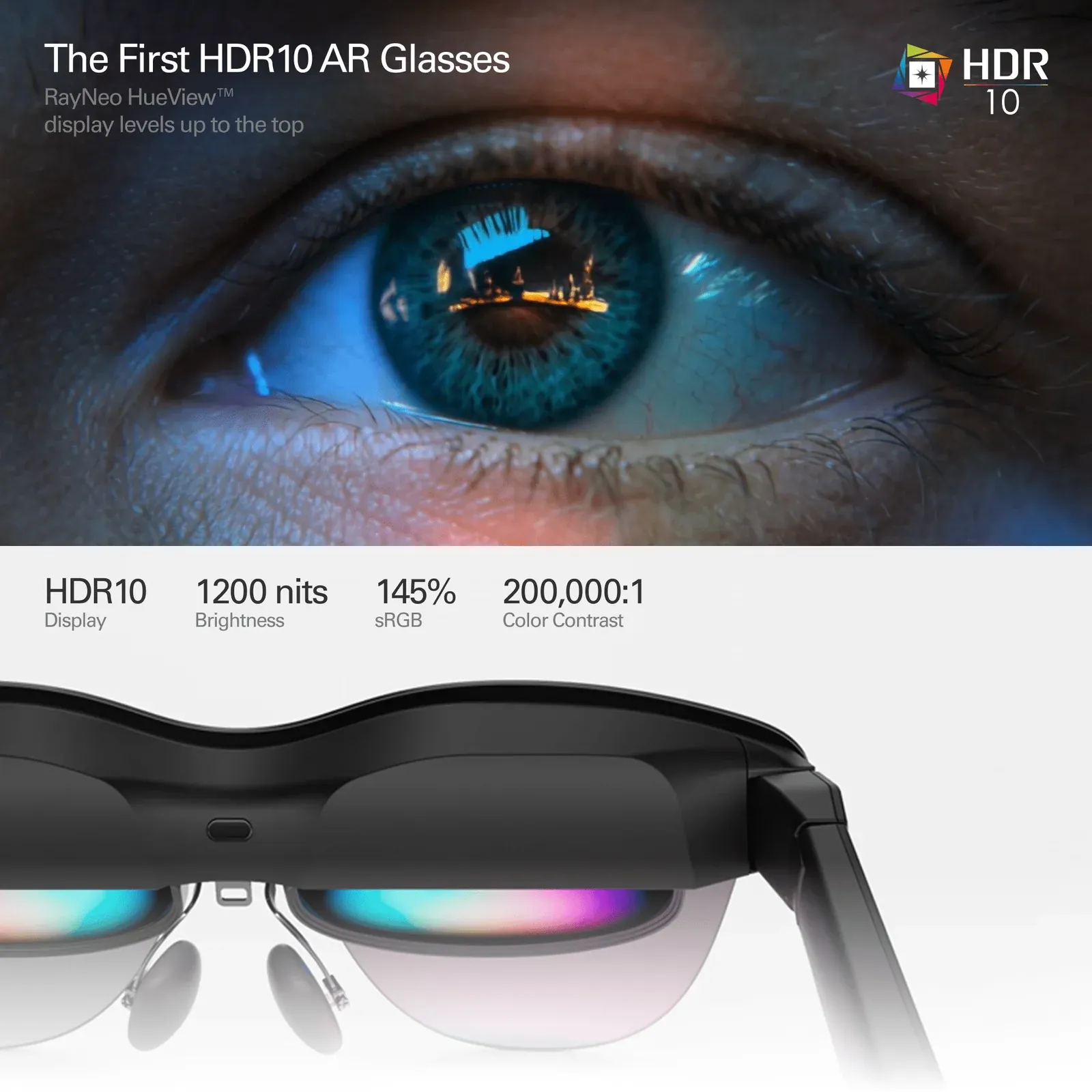
The headline difference is HDR10 — the first AR glasses to carry it. The panel underneath is the same generation as the Air 3s Pro’s. Image: RayNeo.
The prices, plainly
| Model | Price | Notes |
|---|---|---|
| RayNeo Air 4 Pro | $299 | Limited Justice / Chaos editions $319 |
| RayNeo Air 3s Pro | $219 new, $199 refurbished | RayNeo sells a refurb tier directly |
| RayNeo Air 3s | $189 | The non-Pro sibling |
| RayNeo Air 2s | $159 | Previous generation |
| RayNeo Air 2 | $149 | Previous generation |
The refurbished Air 3s Pro is the number that makes this interesting: $199 against $299 is a $100 gap for hardware that, on paper, looks identical.
What is actually identical
This is the table to read carefully, because it is longer than you would expect.
| Spec | Air 3s Pro | Air 4 Pro |
|---|---|---|
| Panel | HueView 2.0, 5.5th-gen tandem Micro-OLED | HueView 2.0, 5.5th-gen tandem Micro-OLED |
| Brightness | 1,200 nits | 1,200 nits |
| Contrast | 200,000:1 | 200,000:1 |
| Colour | 98% DCI-P3 | 98% DCI-P3 / 145% sRGB |
| Virtual screen | 201” at 6 m | 201” at 6 m |
| Refresh rate | 120 Hz | 120 Hz |
| Weight | 76 g | 76 g |
| Weight split | 46.7% front / 53.3% rear | 46.7% front / 53.3% rear |
| Eyebox | 14 × 7 mm | 14 × 7 mm |
| Fit adjustment | 9-level temples, 3-position nose pads | 9-level temples, 3-position nose pads |
| Dimming | 3,840 Hz | 3,840 Hz |
| Eye certification | TÜV SÜD low blue light + flicker-free | TÜV SÜD low blue light + flicker-free |
| Speakers | Quad speaker array, Whisper Mode | Quad speaker array, Whisper Mode |
| Battery | None — powered by host | None — powered by host |
That is not a coincidence or a marketing slip. RayNeo built the Air 4 Pro on the Air 3s Pro’s optical engine and spent the money on processing and audio instead. It is a sensible product decision, but it means you are not paying for a sharper or brighter picture.
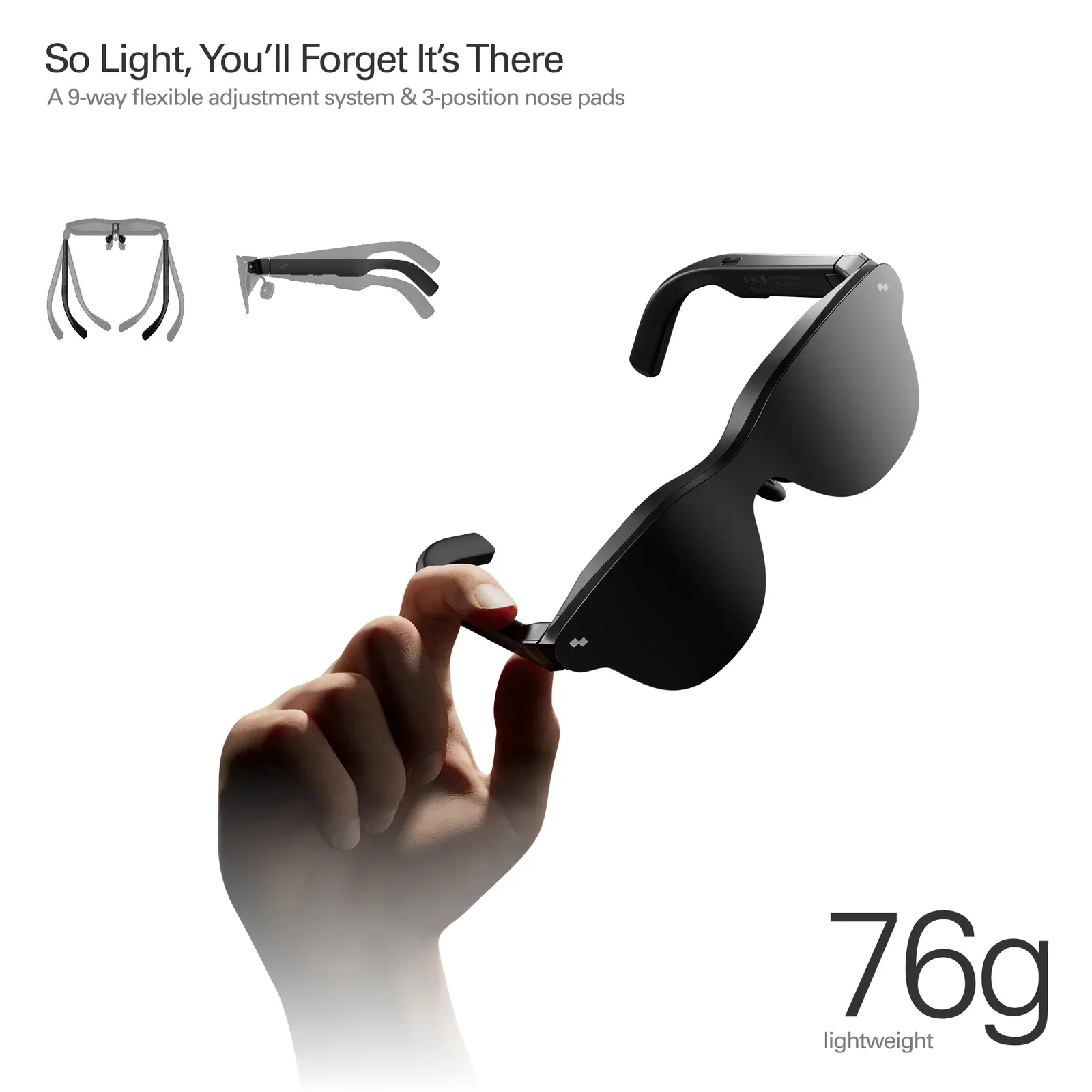
Identical on both models: 76 g, a 9-way flexible adjustment system and 3-position nose pads. Image: RayNeo.
What the $80 actually buys
Three things. All of them are about what happens to the picture and sound before it reaches the panel.
1. HDR10
The Air 4 Pro is the first pair of AR glasses with an HDR10 display. That means it can accept an HDR10 signal and show 10 billion+ colours with a wider luminance range, instead of compressing everything into a standard dynamic range.
In practice: bright highlights stay bright without washing out the shadows. A night scene with streetlights and neon keeps both. On an SDR-only display the same scene flattens.
The catch is the whole chain has to support it — the source device, the operating system, the app, and the content. If you plug into a laptop outputting SDR, HDR10 does nothing. See the spec breakdown for how the chain works.
2. The Pixelworks Vision 4000 processor
This is the part people underrate, and it is arguably more useful than native HDR10.
The Vision 4000 does real-time AI SDR-to-HDR conversion. Most of what you actually watch is still SDR — YouTube uploads, older films, most streaming catalogues, almost all user-generated content. The Vision 4000 remaps the tone curve of that content on the fly so it lands closer to HDR.
That means the Air 4 Pro’s advantage is not limited to HDR10 content. It applies to everything, which is why the two models do not look identical in side-by-side viewing even on the same clip.
The Vision 4000 also handles 2D-to-3D conversion — the Air 4 Pro can turn ordinary video into stereoscopic 3D, and it plays native 3D content at 3840 × 1080. The Air 3s Pro has neither.
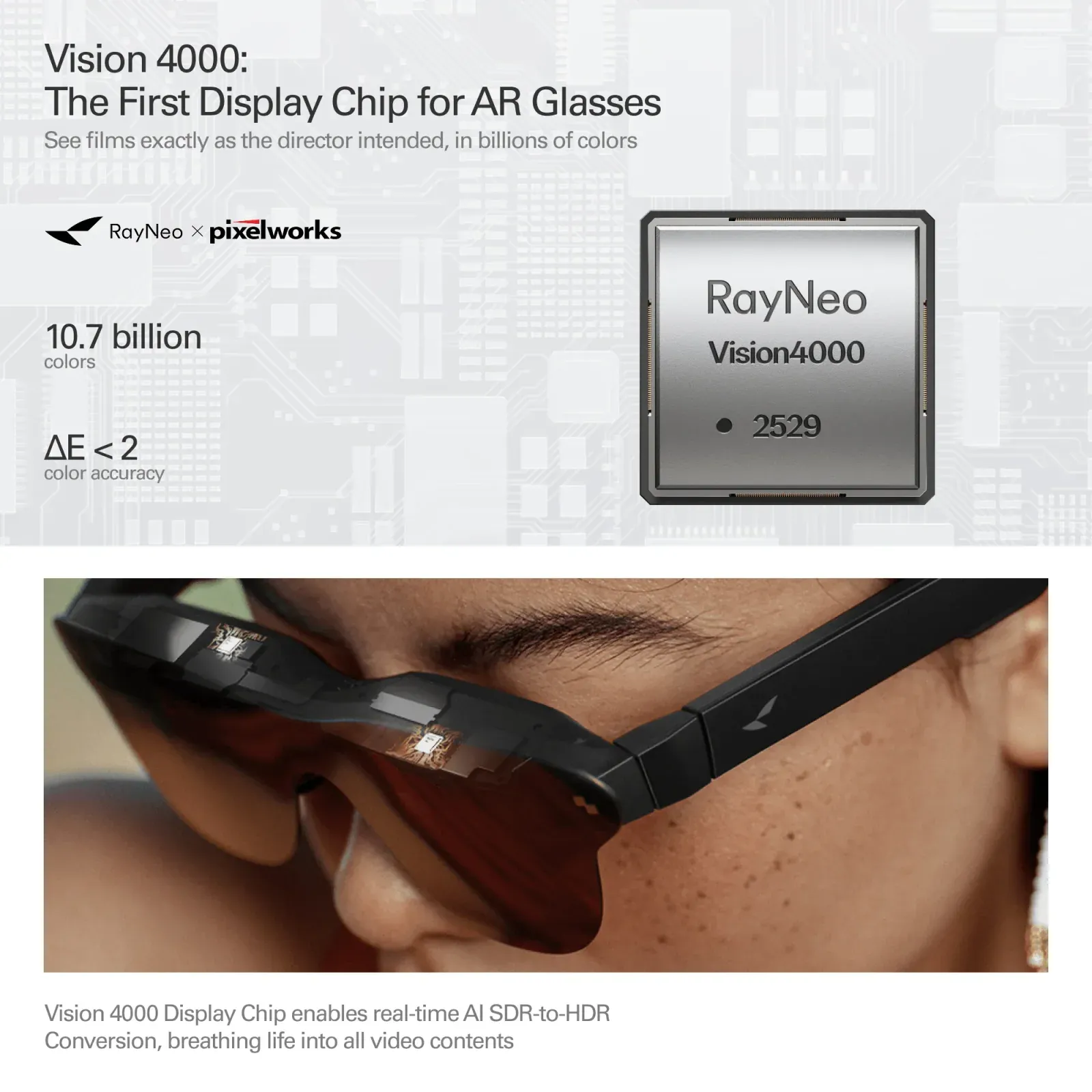
The Vision 4000 handles real-time SDR-to-HDR upscaling and 2D-to-3D conversion. The Air 3s Pro has no equivalent chip. Image: RayNeo.
3. Bang & Olufsen tuning
The Air 4 Pro’s quad-speaker array is co-tuned with Bang & Olufsen. The Air 3s Pro has a quad-speaker system too — RayNeo’s own, with the same Whisper Mode privacy feature — but it is not the B&O collaboration.
How much this matters is subjective. Both are open-ear, both leak at volume, and both benefit from the Sound Tube accessory on a plane. The Air 4 Pro is the better-sounding of the two; it is not a night-and-day difference.
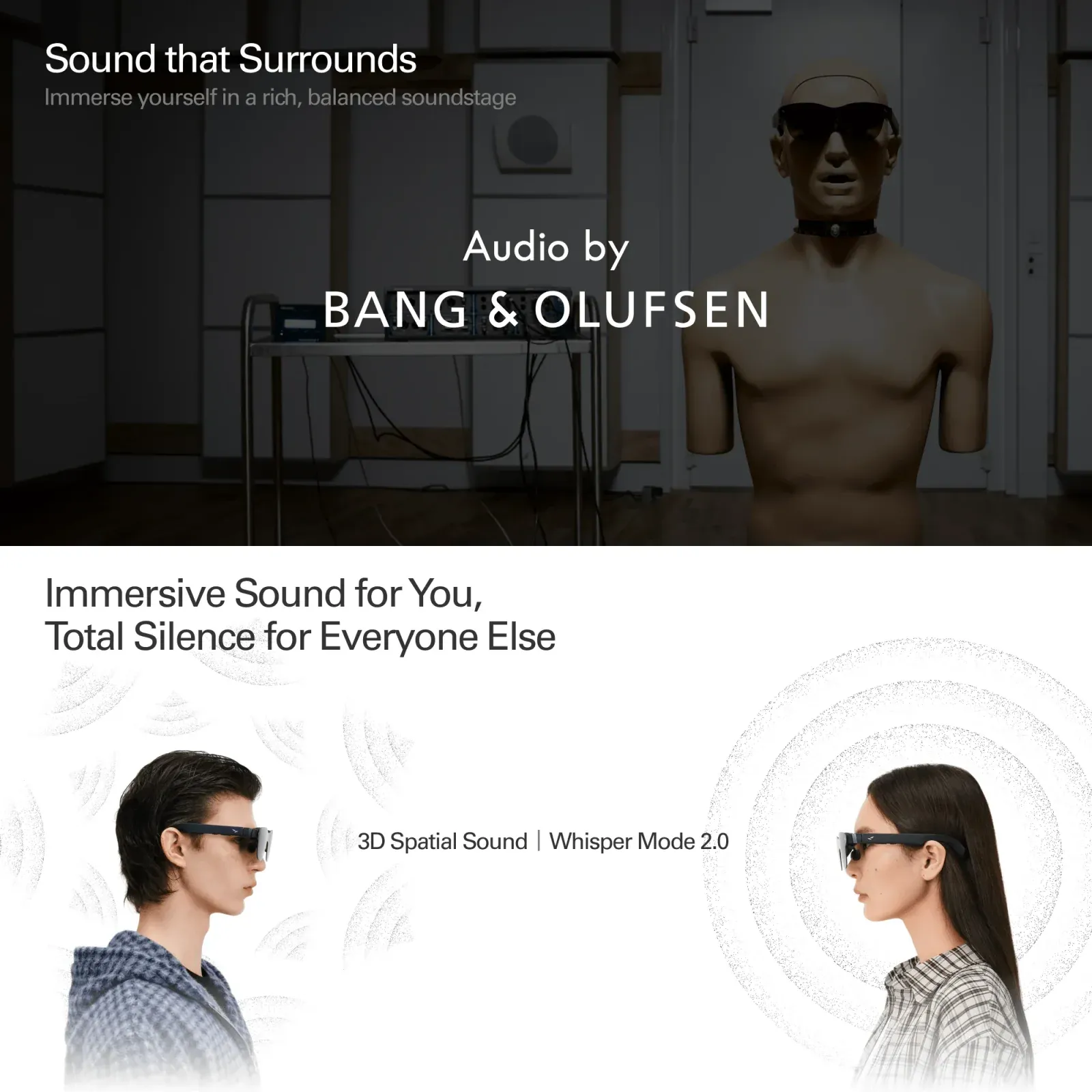
B&O co-tuning is one of the three real differences. Whisper Mode 2.0 is on both models. Image: RayNeo.
So which should you buy?
Buy the Air 3s Pro if you mostly watch SDR content, you want the same optics for less, and you are not interested in 3D. At $219 — or $199 refurbished from RayNeo — you are getting the same panel, the same brightness, the same fit and the same eye certifications. Nothing about the picture quality is a compromise.
Buy the Air 4 Pro if any of these are true:
- You watch a lot of HDR content (modern streaming originals, HDR games, 4K Blu-ray rips) and you want it displayed properly rather than tone-mapped down
- You want the SDR-to-HDR upscaling, which improves the ordinary content that makes up most of your viewing
- You want 3D movies or 2D-to-3D conversion
- You want the better audio and you are not going to add a Sound Tube
The decision rule is simpler than the spec table: the Air 4 Pro is a processing and audio upgrade, not a display upgrade. If your content is mostly SDR and you watch with the built-in speakers, the Air 3s Pro is the better-value buy. If you have HDR sources and care about how they look, the $80 is money well spent.
FAQ
Is the Air 4 Pro’s display better than the Air 3s Pro’s?
Not in panel terms. Both use the same 0.6-inch HueView 2.0 tandem Micro-OLED at 1,200 nits, 200,000:1 contrast and 120 Hz. The Air 4 Pro adds HDR10 support and the Vision 4000 processor, which change how the image is processed rather than how the panel performs.
Does the Air 3s Pro support HDR10?
No. HDR10 is the Air 4 Pro’s headline feature and it is the first AR glasses to carry it. The Air 3s Pro displays standard dynamic range.
Is the Air 3s Pro lighter than the Air 4 Pro?
No — both are 76 g with the same 46.7 / 53.3 front-to-rear weight distribution, the same 9-level temple adjustment and the same 3-position nose pads.
What is the Pixelworks Vision 4000?
The image processor inside the Air 4 Pro. It performs real-time AI SDR-to-HDR upscaling and 2D-to-3D conversion. The Air 3s Pro has no equivalent chip.
Is the Air 3s Pro still worth buying in 2026?
Yes, if you want the Air-series optics without paying for HDR10. It remains on sale from RayNeo, including a refurbished tier at $199, which makes it the cheapest way to get the current-generation panel.
Do both models work with the same accessories?
Yes. Both take the same USB-C charging adapter ($35), HDR10 HDMI adapter ($64), JoyDock ($89) and Sound Tube ($15). Note that the HDMI adapter’s HDR10 passthrough is only useful on the Air 4 Pro — an Air 3s Pro cannot display it.
Can you wear prescription lenses with both?
Yes. Both are designed to take prescription inserts, and RayNeo includes the lens frame with the glasses. See the prescription lens guide.
Related: the full Air 4 Pro review covers the hardware in depth, the spec breakdown explains what each number means, and the buyer’s guide covers the decision from scratch.